You type one sentence about your business into an AI website builder, and a short while later there is a homepage with a headline, pictures and a contact form. The same week a quote from a web designer arrives, and it is a good deal higher than the builder's subscription. It is fair to ask what the difference buys.
We design and build custom websites in Singapore, so we sell one side of this choice, and you should read us with that in mind. We have not run a controlled test of AI builders, and this guide does not review or rank any of them. It is a decision guide: what builders do well, when one is the right call, when a designed website earns its cost, what every website needs whichever tool makes it, and whether a website still matters when customers ask an AI assistant.
Is web design still worth paying for when AI can build a website?
Web design is still worth paying for when the website itself has to win the customer, and it is rarely worth paying for when the website only has to exist. A site that confirms your opening hours to people who already know you has an easy job, and an AI website builder can do it. A site that a stranger compares with three competitors before deciding whom to call has a hard job, and that is where design, writing and photography change the result.
Use a builder if you are a new business testing an idea, if you need a simple site of a few pages that you want to edit yourself, or if the budget is tight. Pay for a designed website if the site has to win the customer, if the brand sells on how it looks and feels, or if you need something a builder cannot do.
What do AI website builders do well today?
AI website builders are good at producing a complete, presentable small website quickly and cheaply. As a category, they typically turn a short description into pages with a sensible layout, draft wording and placeholder pictures, and most adapt that layout to phones and come with hosting, a contact form and an editor the owner can use. Template builders do much the same from a theme you pick. Features differ from one builder to the next, so check the one you are considering. For an owner who needs a website this week on almost no budget, that is a real change.
The layouts also tend to be sound, because builders generally start from page structures people already know, and familiar is good. In a 2012 study at the University of Basel, Alexandre Tuch and colleagues showed screenshots of real websites for a second or less, to 59 participants in one experiment and 82 in another, and the sites rated most appealing were visually simple and looked typical for their kind. Those were mostly students rating screenshots, not customers buying, but it makes a conventional template a reasonable start.
When is an AI website builder the right choice?
An AI website builder is the right choice in three situations: a new business testing an idea, a simple site the owner wants to edit, and a tight budget. Say you have started weekend pottery classes in Joo Chiat and do not yet know whether people will book. A builder site with your dates, fees and a booking link will help you find out, before you spend on design for an unproven idea. The simple site is a few pages, an offer that is easy to explain, and an owner who wants to change the price list on a Sunday night without messaging anyone. And if the choice is between a builder site this month and a designed site some day, launch the builder site.
The downsides: with a hosted builder you usually pay a subscription for as long as the site is live, the design options stop where the builder's blocks stop, and your own time is the hidden cost. Before you start, register the domain in your own name and check that your text and photographs can leave with you.
When does a designed website earn its cost?
A designed website earns its cost in three situations: the website has to win the customer, the brand sells on how it looks and feels, or the site needs something a builder cannot do. The first covers most service businesses that live on enquiries. Say you run a corporate catering company in Bedok and a prospect opens your site beside two others: the site has to earn that call. The second covers tailors, interior designers, restaurants and anyone whose customers buy a feeling before a product. The old website of Voilà, a family run interior design studio, ran on an off the shelf theme shared with thousands of other sites. The site we built for them puts the finished homes first.
The third situation is capability: you want something that is not among your builder's blocks. Our sites are custom built in code, which our FAQ gives as the reason they can carry effects such as scroll driven animation. Builders differ, and some include motion options of their own, so check what yours offers first. The gallery shown here is a small example: five panels stand side by side, and the one you click springs open, overshooting slightly before it settles. The honest downside: a designed site usually costs more and takes longer, and motion adds nothing if the photographs and words underneath are weak.
Why do AI built websites tend to look and sound alike?
AI built websites tend to look and sound alike because a generative model produces a likely answer to the request it is given, and thousands of businesses give it nearly the same request. We offer this as reasoning, and we know of no study that measures it. A one sentence brief for a florist returns the headline that would suit any florist, and the layouts, colours and stock style pictures tend to come from a shared pool of defaults. We list the visual tells in what makes a website look premium.
The sameness that costs you is in the content more than the layout. What hurts is a headline and a photograph that could sit on a competitor's site unchanged, because neither tells a visitor why to choose you. The tool cannot know your customers, your area or what you refuse to do unless you tell it. If you use a builder, treat its first version as a draft and rewrite the first screen yourself, using the three questions in our guide to homepage headlines.
What does every website need, whichever tool builds it?
Every website needs real photographs and a clear first screen, whichever tool builds it, and a builder cannot supply either until you give it your own pictures and your own words. Jakob Nielsen reported in Photos as Web Content in 2010 that people in eyetracking research looked closely at pictures of real products and real people, and ignored generic stock images. The article gives examples and no overall percentage, so treat it as an observation. Replacing a builder's placeholder pictures with your own is, in our view, the most useful edit you can make.
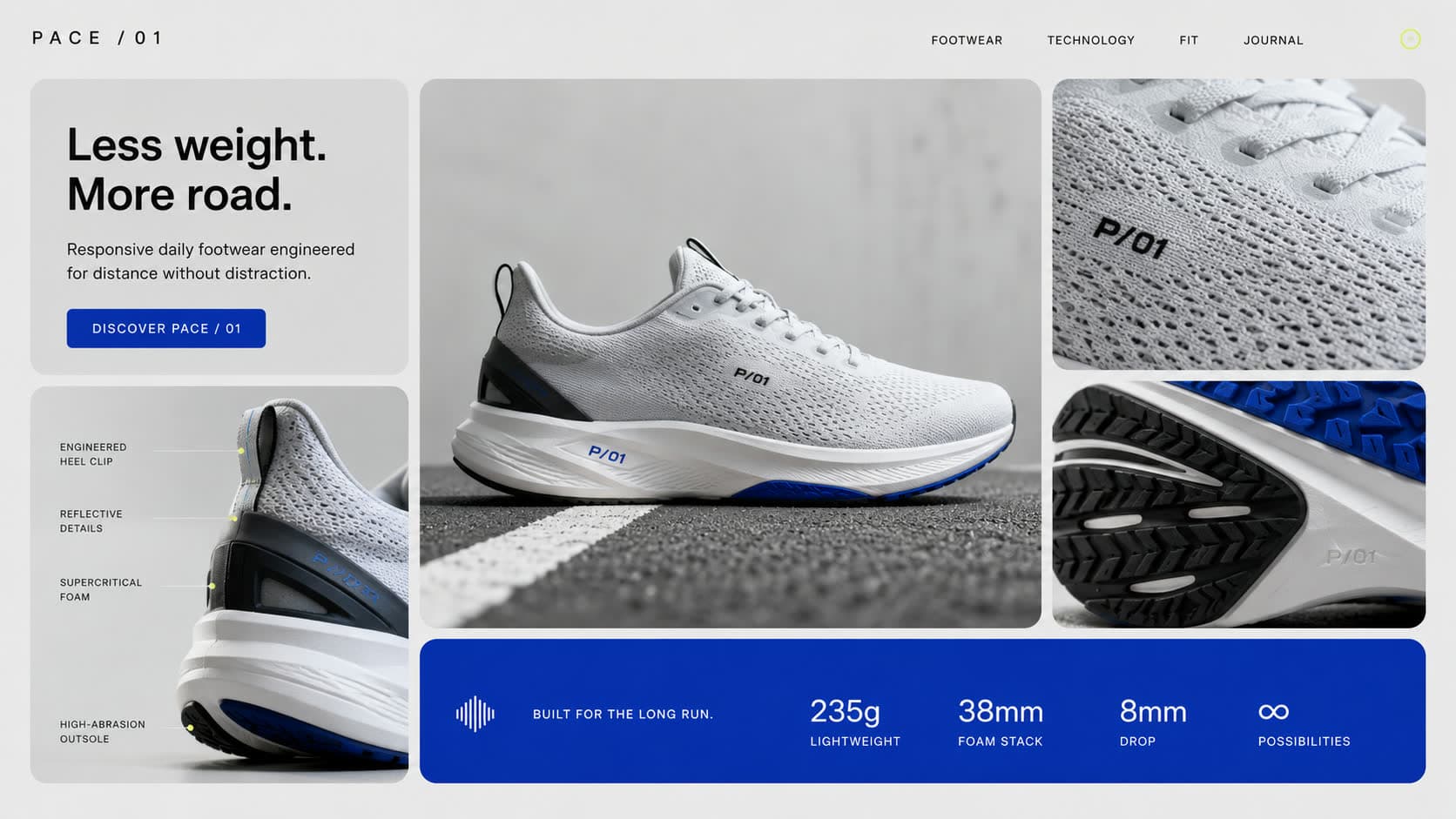
On the first screen, a Nielsen Norman Group eyetracking study published in 2018 found that 120 participants spent about 57% of their page viewing time above the fold, the part visible without scrolling. That was measured on desktop screens, so read it as a direction. In the hero layout shown here, the headline sits in one tile and photographs of the product fill the tiles around it, so the claim and the evidence arrive together. A builder can give you the tiles. The sentence that names your customer and the photograph of your actual work have to come from you.
Can a website builder make a business look trustworthy?
A website builder can make a business look tidy, but what makes it look trustworthy has to be supplied by the business. The best known evidence is the Stanford Guidelines for Web Credibility, ten guidelines that B.J. Fogg's lab published in 2002, based on three years of research that included over 4,500 people. One is about design: make the site look professional, or appropriate for its purpose. A decent template covers that one. Several others ask for things no tool can generate: show that a real organisation is behind the site, show that honest and trustworthy people stand behind it, and make it easy to contact you.
In practice that means a named owner, a real address and reviews from customers who exist. The pattern shown here presents reviews one card at a time, the next ones waiting behind, so each is read properly. It is only worth building if the quotes are real. The research is over twenty years old, though in our experience its advice still holds. How Google thinks about trust is covered in E-E-A-T explained.
Does Google penalise a website made with AI?
Google's published guidance does not penalise a website for being made with AI, and it does not reward one for it either. Google's guidance about AI generated content, published on 8 February 2023, says that appropriate use of AI or automation is not against its guidelines, and that using AI gives content no special gains. We know of no Google statement that the tool a site is built with changes how it ranks.
There are two limits. Google's spam policies define scaled content abuse as generating many pages mainly to manipulate search rankings and not to help users, and the first example they give is using generative AI tools to produce many pages without adding value. And Google's guidance on generative AI content calls it critical to fact check and review AI generated content by hand before publishing. We read all three pages on 21 November 2026. Our reading: an AI drafted services page that you have corrected and filled with your own facts is fine, and fifty near identical area pages generated in an afternoon are a risk. More in how to write content that ranks.
Does a website still matter when customers ask AI assistants?
A website still matters when customers ask AI assistants, because the assistants rely on web pages for current facts. When a question needs current information, an assistant runs web searches, reads the pages it finds and cites some of them, as explained in how AI search works. Google's page AI features and your website says a page must be indexed and eligible to be shown in Google Search with a snippet to appear as a supporting link in AI Overviews or AI Mode, and that there are no additional requirements (checked 21 November 2026).
So a business with no website, or a page of vague generated text, gives an assistant little to quote. Your own site is the one place where you decide what the facts about your business are: what you do, where, for whom and at what hours. That holds for a builder site and a designed one alike, and neither guarantees a mention. The practical steps are in how to get recommended by ChatGPT and AI search.
What does a designed website cost, and how long does it take?
A designed website has no standard price, and we do not publish one, because every project is scoped and quoted individually. What moves a quote is scope: how many pages, which features, and how much custom design and animation the brief calls for. With us you get one fixed figure in writing before any work begins, and payment is half to begin and half once you have approved the finished site, before it goes live.
Our starting package is usually live within a week of receiving your content, and larger builds take two to three weeks, for reasons set out in how long a website takes to build. A builder is usually quicker to a first version, though the hours of writing and choosing pictures fall to you. When you compare the two routes, count the subscription over the years you expect to keep the site, and your own time.
Can you start with a builder and move to a designed website later?
You can start with a builder and move to a designed website later, and for a new business that is often the sensible order. What carries over is everything that was truly yours: the domain, the photographs, the wording that worked, the reviews, and what a year of enquiries taught you. The design itself usually stays behind. Move when the site has become the thing that wins or loses customers and the builder's blocks stop you improving it.
The risk in moving is losing the search positions the old site had earned. When we rebuilt the website of the tailor Ron & Rich, which had been a store template, every old address was redirected to its closest new page, the step that protects what a site already ranks for. The steps are in our guide to a website redesign in Singapore.
How to decide this week
The quickest way to decide between an AI website builder and a web designer is to write down, in one sentence, the job your website has to do. If the job is to exist and show the basics, open a builder, and put in your own photographs and your own first sentence before you publish. If the job is to win customers who are comparing you with others, count how many enquiries the current site brings in a month and what one more would be worth to you.
Either way, run three checks on the result. Are the photographs real? Does the first screen say whom you serve and what they get? Can a stranger see that real people run the business? The tools section of what makes a good website has more on templates and custom builds. If you would like a second opinion, send us the link on WhatsApp or through our contact page. We will tell you plainly if a builder would serve you just as well.